Watcher or Doer?
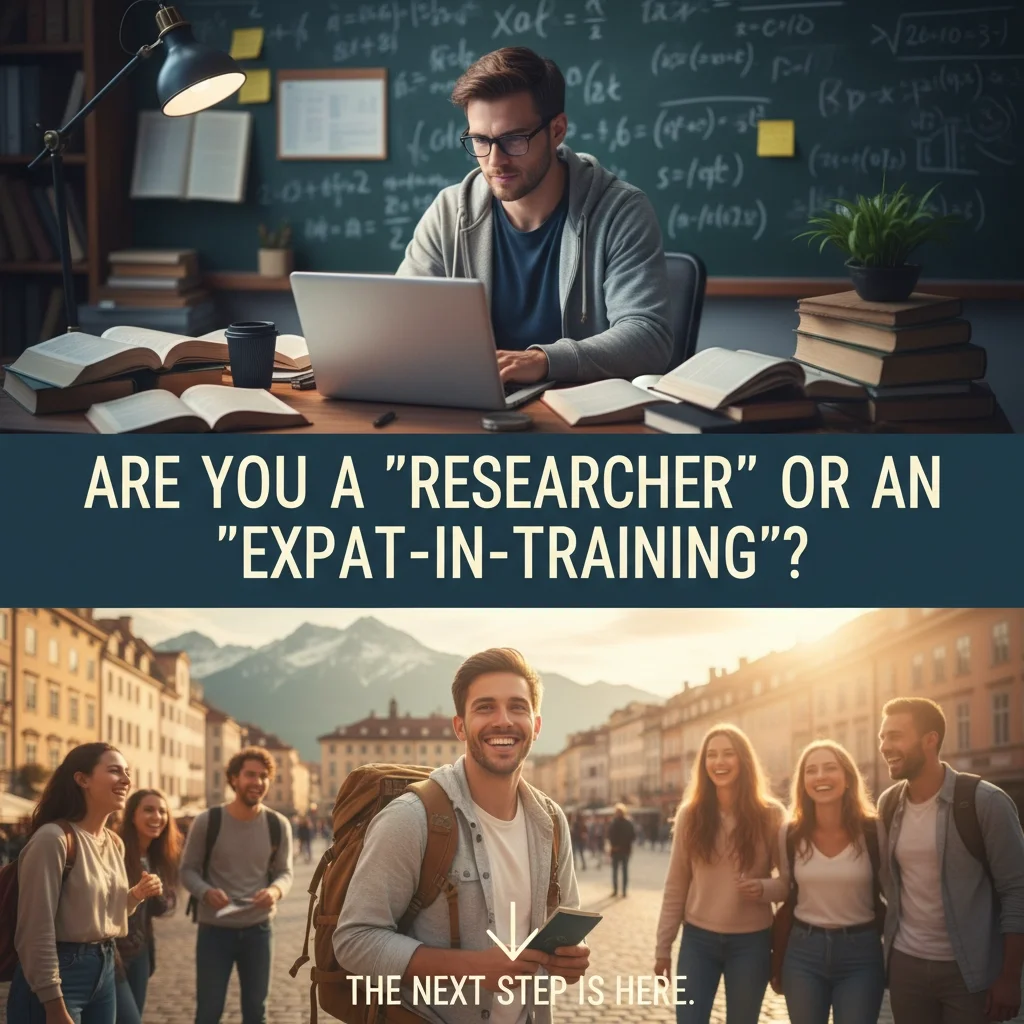
Here's the truth, fellow veteran: You've spent months: maybe years: diving deep into visa requirements, cost of living calculators, and expat forums. You know the difference between Spain's Non-Lucrative Visa and Panama's Pensionado program. You've bookmarked dozens of articles about healthcare options and apostille procedures.
You're officially a researcher.
But there's a critical question you need to ask yourself right now: Are you ready to graduate from researcher to expat-in-training?
The Research Phase is Over
Let's be honest about where you are. You've done the groundwork. You know your "why": whether it's stretching your VA benefits further, escaping the political chaos, or simply living the adventure you earned through your service. You've mapped out the visa paths that make sense for veterans like us: Spain's straightforward residency requirements, Panama's immediate permanent residency advantage.
You even know the roadblocks that trip up most people: the dossier paperwork nightmare, navigating foreign healthcare systems, and the dozens of little details that can derail an unprepared move.
The research phase served its purpose. Now it's time to stop researching and start doing.

From Knowledge to Action
Here's what separates successful expat veterans from perpetual researchers: execution. The difference between someone who talks about moving abroad for five years versus someone who's booking their one-way ticket in six months comes down to having a structured, step-by-step plan with accountability.
You can read every blog post about expat life (trust me, I've written most of them), but at some point, you need to transition from consuming information to implementing systems.
That's exactly why I'm announcing something big.
Introducing the TGDP Premium Hub: Phase 5
Very soon, I'm launching the TGDP Premium Hub: what I consider "Phase 5" of our strategic expat plan. This isn't another general expat group or generic relocation service. This is designed specifically for a small, focused group of "Founding Members" who are 100% serious about making their international move happen in 2026.
No tire-kickers. No dreamers who'll still be "researching" in 2030. This is for veterans ready to execute.
What's Inside the Premium Hub
The A-to-Z Visa Blueprint: In-depth courses that walk you through every single step of your chosen visa process. No more piecing together information from random forums or outdated government websites. You'll get the complete playbook, updated for 2026 requirements.
Live Monthly Q&A Calls with Me: Direct access for your specific questions, roadblocks, and situations. This isn't a webinar where you submit questions hoping they get answered. This is real-time problem-solving for your unique circumstances.
The "Financial Dossier Prep & Review" Service: The financial documentation requirements are where most people stumble. We'll review your specific situation, help you organize your paperwork, and ensure you're presenting your VA benefits and financial picture in the strongest possible way.

The Founding Member Advantage
Here's what makes this special: I'm limiting this first cohort to ensure everyone gets personalized attention and real results. Founding Members will get locked-in pricing that will never increase, even as we add more resources and expand the program.
But here's the key detail: I'm announcing the "Founding Member" discount exclusively to our free Veteran Expat Hub community first.
If you're not already in our free hub, you'll miss the early-bird pricing and potentially miss your spot entirely.
This is Your Moment
Look, I get it. Making the jump from researcher to expat-in-training feels significant: because it is. You're moving from theoretical planning to committed action. From browsing possibilities to building your exit strategy.
But here's what I know after helping hundreds of veterans make this transition: The planning phase is where dreams become reality. The veterans who succeed are the ones who stop consuming endless information and start executing a proven system.
2026 is closer than you think. If you're serious about making this move, the time for research is over. The time for strategic action is now.
Ready to start your journey? The real planning happens in our free 'Veteran Expat Hub' on Skool. Click here to join the free hub and get on the waitlist: https://www.skool.com/tgdp-the-veteran-expat-hub-4901
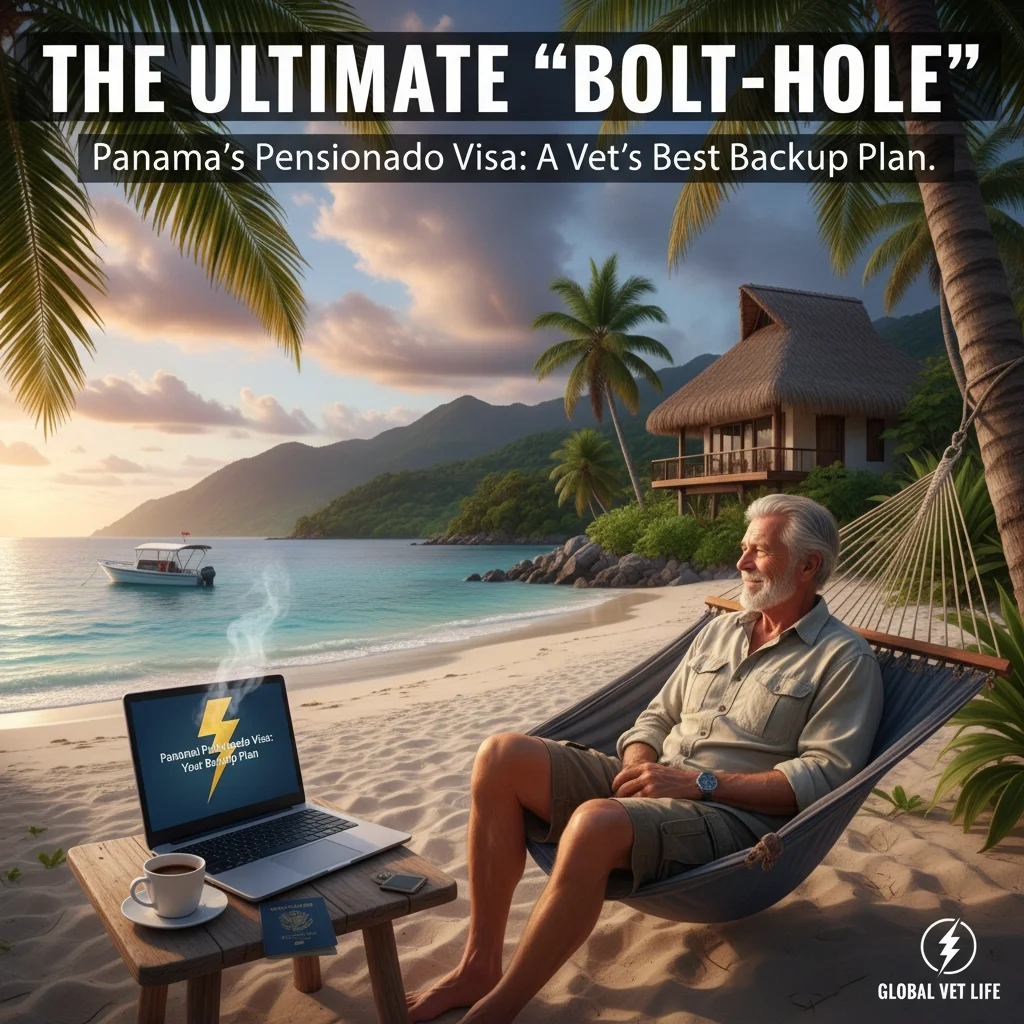
The Ultimate "Bolt-Hole": Why Panama's Pensionado Visa is a Vet's Best Backup Plan
Every veteran knows the value of a solid backup plan. Whether it was an alternate extraction route, redundant communication systems, or contingency supplies, having options kept us alive downrange. The same strategic thinking applies to your civilian life: especially when it comes to where you can legally live and work.
If you're a U.S. veteran exploring international residency options, Panama's Pensionado Visa isn't just another retirement program. It's the gold standard "bolt-hole": a immediate, permanent backup plan that leverages the benefits you've already earned through your service.
Here's why every strategic-minded veteran should have Panama's Pensionado Visa in their back pocket, and how your VA disability benefits make you the perfect candidate.
What Makes a "Bolt-Hole" Different From Regular Expat Living

Before we dive into Panama specifically, let's clarify what we mean by "bolt-hole." This isn't about becoming a digital nomad or spending a few months abroad. A bolt-hole is a legally secure, permanent residency option that you can activate quickly if circumstances in your home country change.
Think of it as your strategic reserve. You might never need to fully relocate, but having legal residency established in a stable, veteran-friendly country gives you options. And in an uncertain world, options equal security.
Panama's Pensionado Visa delivers this security better than any other program because it grants immediate permanent residency from day one. No temporary status, no waiting periods, no annual renewals to worry about. You get it, you keep it.
The Magic Number: Why $1,000/Month Changes Everything
Panama's Pensionado Visa has one core requirement that makes it accessible to most veterans: proof of a lifetime pension of just $1,000 per month. That's it. No complex investment requirements, no property purchases, no language tests.
For context, many European residency programs require €15,000-30,000+ in annual passive income (roughly $1,250-2,500 monthly). Panama's requirement is not only lower: it's specifically designed for people with pensions, not investment portfolios.
This isn't about being wealthy. It's about being strategic with the benefits you've already earned.
Your VA Benefits: The Golden Key to Panama

Here's where it gets interesting for veterans. Your VA disability compensation isn't just monthly income: it's guaranteed lifetime pension income. And that's exactly what Panama's immigration officials want to see.
Your VA benefits letter serves as ironclad proof that you meet Panama's pension requirement. No complex financial documentation, no proving investment returns, no explaining business income. Your service-connected benefits provide the cleanest, most straightforward qualification path possible.
Whether you receive 30%, 50%, 70%, or 100% disability compensation, if your monthly amount hits that $1,000 threshold, you qualify. Period.
Even better, VA benefits are inflation-protected and guaranteed for life. Immigration officials recognize this stability. While other applicants struggle to prove their income sustainability, your VA letter does the heavy lifting.
The Bolt-Hole Advantage: Set It and Forget It
Panama's Pensionado Visa offers something most other residency programs don't: virtually no physical presence requirement. Once you have your permanent residency, you can maintain it while living anywhere in the world.
Compare this to Portugal's Golden Visa (requires spending at least 7 days per year in Portugal) or Spain's Non-Lucrative Visa (requires spending at least 183 days per year in Spain). Panama? You could visit once every few years and maintain your status.
This flexibility makes Panama perfect as a backup plan. You can obtain residency, return to the U.S., and know you have a legal right to live in Panama whenever circumstances change. It's the ultimate "set it and forget it" residency option.
The Two-Flag Strategy: Why Panama Completes the Picture

Smart veterans don't put all their eggs in one basket, and the same principle applies to international residency. The "Two-Flag Strategy" involves holding residency in two different countries: typically one "anchor" country where you spend most of your time, and one "bolt-hole" where you maintain backup residency.
Panama excels as the bolt-hole component because:
Immediate permanent status (no temporary phases)
Minimal presence requirements (maintain while living elsewhere)
Political stability (long history of welcoming American retirees)
Geographic convenience (close to the U.S., direct flights)
Dollar economy (no currency exchange complications)
You might choose Spain or Portugal as your primary residence for lifestyle reasons, but Panama provides the legal security blanket. If anything changes with your primary residency, you have immediate legal status in Panama.
The Process: Boots on Ground, Get It Done
Unlike many residency programs that allow remote applications, Panama requires you to be physically present during the application process. This isn't a drawback: it's actually an advantage for veterans who prefer direct, personal handling of important matters.
Here's the straightforward process:
Step 1: Travel to Panama as a tourist (U.S. citizens get 90 days visa-free)
Step 2: Hire a reputable Panamanian immigration lawyer (this is mandatory: no DIY applications)
Step 3: Submit your prepared dossier including:
Your VA benefits letter (recent, within 90 days)
Apostilled FBI background check
Apostilled birth certificate
Certified Spanish translations of all English documents
Bank statements and financial documentation
Step 4: Complete biometrics and interviews as required
The entire process often takes 2-4 months, during which you can stay in Panama or return to the U.S. while your lawyer handles the bureaucratic components.
Why Panama Works Specifically for Veterans

Panama has a long history of welcoming American military personnel and retirees. The country offers specific benefits to Pensionado visa holders, including:
Discounts on medical services, medications, and utilities
Tax advantages on foreign-sourced income (your VA benefits)
Simplified banking (U.S. dollar is the official currency)
Strong American expat community with veteran networks
High-quality, affordable healthcare
The cultural familiarity factor matters. Panama has been connected to American military presence for decades. You'll find established American communities, English-speaking services, and infrastructure designed around U.S. standards.
Strategic Considerations: When Panama Makes Sense
Panama's Pensionado Visa isn't right for everyone, but it's perfect for veterans who:
Want immediate, permanent residency as a backup plan
Meet the $1,000/month pension requirement through VA benefits
Prefer straightforward processes over complex investment schemes
Value political and economic stability
Want to maintain primary residence elsewhere while securing backup options
This program shines as part of a broader international strategy, not necessarily as your primary relocation target. It's the insurance policy that gives you options when you need them most.
Getting Started: Document Preparation
Success with Panama's Pensionado Visa starts with proper document preparation. Your VA benefits letter is the cornerstone, but you'll need additional documentation apostilled and translated.
Start the apostille process early: this often takes several weeks through the U.S. Department of State. Your FBI background check also requires apostille certification, and this document has a limited validity period.
Working with an experienced Panamanian immigration attorney isn't optional: it's required by law. Choose someone with a proven track record handling U.S. veteran applications. They understand the specific documentation requirements and can expedite the process.
The investment in proper legal representation pays dividends in speed, accuracy, and peace of mind. This isn't the place to cut corners.
Your Next Move: Building the Complete Strategy
Panama's Pensionado Visa represents one component of a comprehensive international residency strategy. It's your backup plan, your insurance policy, your strategic reserve.
The beauty of this program lies in its simplicity and your existing qualifications. Your service earned you benefits that open doors most civilians can't access. Panama's Pensionado Visa proves that those benefits extend far beyond monthly payments: they provide international options and strategic flexibility.
For veterans serious about international residency options, Panama deserves serious consideration. Not as your only option, but as the foundation of a multi-flag strategy that maximizes your freedom and minimizes your risk.
Learn more about building your complete international strategy at theglobaldomicileproject.com, including detailed guides on document preparation, attorney selection, and coordinating multiple residency programs.
Ready to start your journey? The real planning happens in our free 'Veteran Expat Hub' on Skool. Click here to join the free hub and get the playbook: https://www.skool.com/tgdp-the-veteran-expat-hub-4901
The Schengen Shuffle
Spain vs Portugal vs Germany: Which Schengen Country Is Best for Maximizing Your VA Disability Benefits?
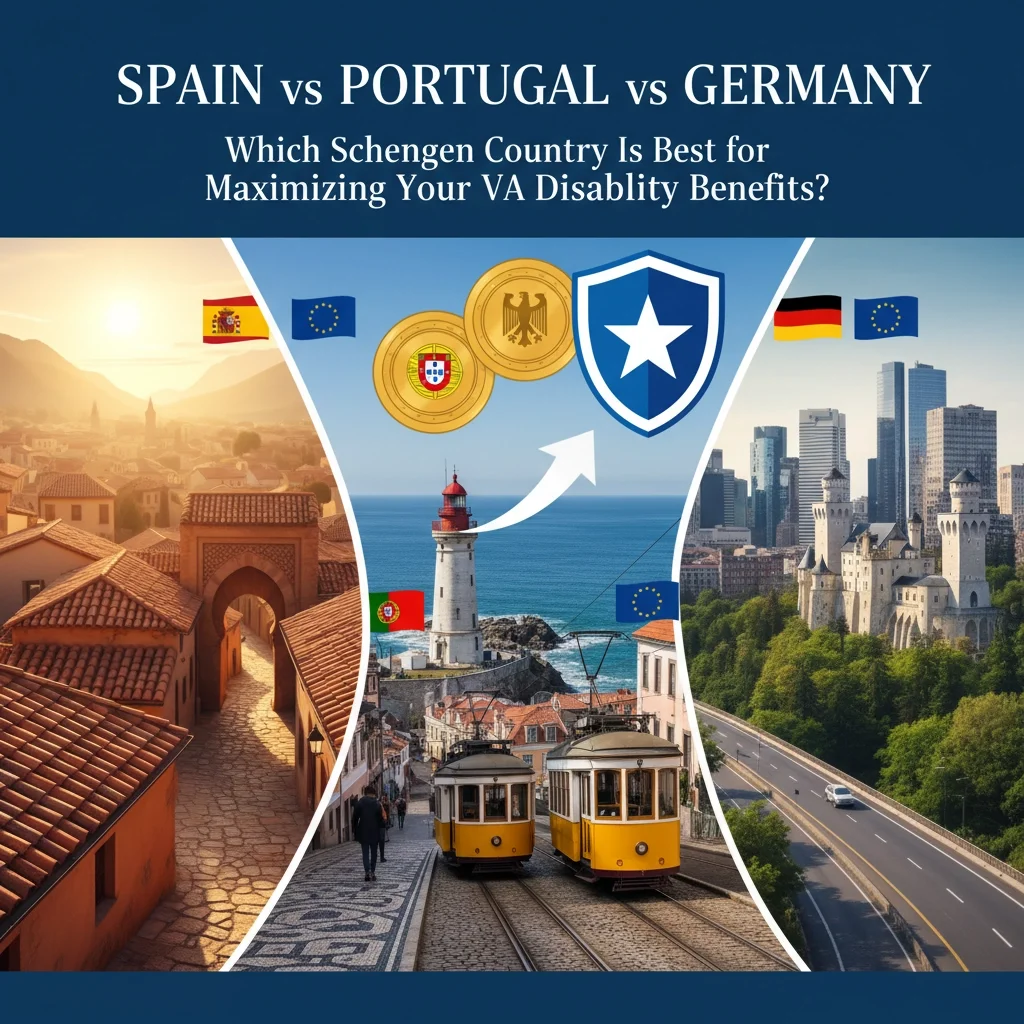
Choosing where to live abroad as a veteran isn't just about finding a nice place with good weather. It's about maximizing your purchasing power, maintaining your benefits, and finding a country that actually wants you there. If you're considering Europe, the Schengen Area offers incredible freedom of movement: but not all Schengen countries are created equal for veterans living on VA disability income.
Today, we're breaking down three popular European destinations: Spain, Portugal, and Germany. Each offers unique advantages, but one stands out as having the lowest barrier to entry for veterans looking to establish residency using their VA disability benefits.
Portugal: The Clear Winner for Low-Income Veterans

Let's cut to the chase: Portugal has the lowest monetary requirements for residency in Europe, making it the most accessible option for veterans with lower disability ratings.
The D7 Visa Advantage
Portugal's D7 visa (also called the "retirement visa") requires proof of only €635 per month ($737/month) in passive income. For veterans, your VA disability compensation counts as qualifying income, regardless of your rating percentage. This means even a 10% disability rating (around $165/month) can be supplemented with other sources to meet Portugal's threshold.
Compare this to Spain's Non-Lucrative Visa requiring around €2,200 per month ($2,552/month), and you'll see why Portugal is the veteran-friendly choice.
Cost of Living Reality Check
Your dollar stretches significantly further in Portugal:
Average rent for a 1-bedroom apartment: €400-600 ($464-696) outside Lisbon/Porto
Monthly groceries for one person: €150-200 ($174-232)
Healthcare through SNS (national health service): Heavily subsidized
Utilities (electricity, water, internet): €80-120/month ($93-139/month)
A veteran with a 50% disability rating ($958/month) can live comfortably in many Portuguese cities, something that's nearly impossible in Germany or Spain's major metropolitan areas.
Veteran Community and Support
Portugal has been actively courting American retirees and veterans. The growing expat community means:
English-speaking healthcare providers in major cities
Established veteran support networks
American-style services and amenities
Easier banking and bureaucratic processes for Americans
Spain: Beautiful but Expensive

Spain offers incredible culture, climate, and lifestyle: but it comes at a cost that many veterans find prohibitive.
Residency Requirements
Spain's Non-Lucrative Visa demands proof of €2,200+ monthly income ($2,552+/month), plus:
€25,000+ in bank savings ($29,000+)
Private health insurance (€100-300/month) ($116-348/month)
Proof of accommodation
No permission to work during your first year
For most veterans, this eliminates Spain unless you have a 100% disability rating combined with additional retirement income.
Regional Cost Variations
Spain's costs vary dramatically by region:
Madrid/Barcelona: €1,000-1,500/month rent ($1,160-1,740/month) for decent housing
Valencia/Seville: €600-900/month rent ($696-1,044/month)
Rural areas: €300-500/month rent ($348-580/month) (but limited services/community)
Even in cheaper regions, the initial residency requirements create a significant barrier that Portugal simply doesn't have.
The Healthcare Question
Spain's healthcare system is excellent, but accessing it as a non-EU resident requires:
Private insurance initially
Contributing to the social security system
Navigating bureaucracy primarily in Spanish
While not insurmountable, it's more complex than Portugal's approach.
Germany: Infrastructure with a Price Tag

Germany offers something unique for veterans: established military infrastructure and veteran services, but at Northern European prices.
Veteran-Friendly Infrastructure
Germany stands out for its existing veteran support:
VA-authorized medical facilities
Military commissary and exchange privileges for disabled veterans
Established American military communities
English-speaking medical services on bases
This infrastructure can be invaluable for veterans needing specialized care or those who want to maintain closer ties to military culture.
The Residence Permit Reality
Germany doesn't have a simple "retirement visa" like Portugal or Spain. Instead, you'll need:
Proof of financial independence (€1,500-2,000/month minimum) ($1,740-2,320/month)
Health insurance from day one
Language requirements for permanent residency
Complex bureaucratic processes
Cost of Living Challenges
Germany's costs reflect its Northern European location:
Average rent: €800-1,200/month ($928-1,392/month) in major cities
Health insurance: €300-500/month ($348-580/month) for private coverage
Food and utilities: 30-50% higher than Portugal
Transportation: Excellent but expensive
A veteran would need at least 70-80% disability rating plus additional income to live comfortably in most German cities.
The Bottom Line Comparison

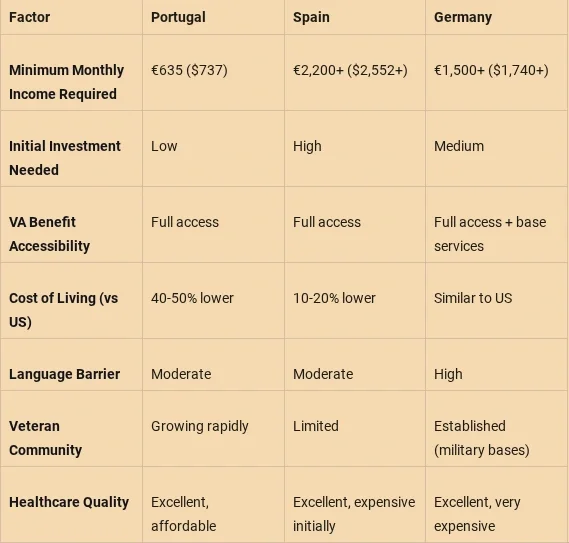
Making Your Decision
The choice between these three countries ultimately depends on your disability rating and financial situation:
Choose Portugal if:
You have a lower disability rating (10-60%)
You want the easiest path to European residency
Cost of living is your primary concern
You prefer a growing, welcoming expat community
Choose Spain if:
You have 100% disability rating plus additional income
Culture and lifestyle outweigh financial considerations
You're comfortable with higher barriers to entry
You speak Spanish or are committed to learning
Choose Germany if:
You need specialized VA medical care
You have significant additional income beyond VA benefits
You value established veteran infrastructure
You're willing to invest heavily for long-term stability
Next Steps for Veterans
Before making any moves, take these practical steps:
Calculate your total monthly income from all sources, not just VA disability
Research tax implications of receiving VA benefits while residing in each country
Connect with veteran communities in your target country through Facebook groups or forums
Consult with The Global Domicile Project for personalized guidance on residency applications
Remember, your VA disability benefits are earned and deserved. The question isn't whether you should live abroad: it's finding the country that maximizes those benefits while giving you the quality of life you've earned through your service.
Portugal's low barriers make it the most accessible option for the majority of veterans, but the "best" choice is the one that aligns with your specific financial situation, health needs, and lifestyle preferences.
Ready to explore your options? Visit The Global Domicile Project to learn how we help veterans navigate international residency and maximize their benefits abroad.
Your VA Letter Isn't Enough: 5 Keys to a Perfect Financial Dossier
It all begins with an idea.
You've done your research. You've picked your target country. You've even identified the perfect visa program that fits your VA disability income. But here's where most veterans fail: they walk into the consulate with a crumpled manila envelope full of random documents, hoping their VA benefits letter will carry the day.
It won't.
Here's the hard truth from someone who's been there: foreign consulates see hundreds of applications every month. Half of them are from people who think their government benefits automatically qualify them for residency anywhere in the world. The other half are from serious applicants who understand that presentation matters as much as qualification.
Which half do you think gets approved faster?
At The Global Domicile Project, we've learned that the difference between approval and rejection often comes down to one thing: professionalism. Your VA disability income might be guaranteed for life, but if you can't present it professionally, you're just another veteran with unrealistic expectations.
The solution? A Financial Dossier: not a pile of papers.
What Separates a Dossier from a Pile of Papers
Let's be clear about something: there's a massive difference between showing up with a stack of photocopied documents and presenting a professional Financial Dossier. One screams "amateur hour," while the other demonstrates you're a serious applicant who respects the process.
A Financial Dossier is a single, bound document (PDF or physical binder) that contains every piece of financial evidence a consular officer needs to approve your visa application. It's organized, complete, and designed to make their job easier: not harder.
Think about it from their perspective. Consular officers process dozens of applications daily. When they open your file, do you want them to see scattered papers they have to piece together, or a professional presentation that answers every question before they ask it?
The dossier approach works because it demonstrates three critical things: preparation, seriousness, and respect for their process. These are exactly the qualities consulates want to see in long-term residents.
The 5 Keys to Your Perfect Financial Dossier
Key #1: The Cover Letter (Your First Impression)
Your dossier must start with a formal cover letter addressed directly to the consulate. This isn't a casual note: it's a professional document that establishes your credibility from page one.
Your cover letter should clearly state who you are, which visa you're applying for, and most importantly, how your guaranteed VA income ensures you won't become a burden on their social systems. This is where you transform from "another American retiree" to "a financially stable veteran with guaranteed government income."
The cover letter sets the tone for everything that follows. Make it count.
Key #2: Proof of Income (The Golden Key)
Here's what most veterans get wrong: they think any VA paperwork will suffice. Wrong. You need your official VA Benefits Letter, and it must be recent: less than 90 days old.
This letter is your golden key because it proves three essential things: your income is guaranteed by the U.S. government, it's permanent (or long-term), and the amount meets or exceeds the visa requirements.
But here's the critical part: don't just include the letter. Include a brief explanation of what VA disability benefits are, how they're calculated, and why they're guaranteed. Remember, foreign officials may not understand the U.S. veterans' benefits system. Your job is to educate them while proving your qualification.
Key #3: Proof of Funds (Your Safety Net)
Even with guaranteed passive income from VA disability, consulates want to see you have savings. This proves you can handle unexpected expenses without becoming their problem.
You'll need 6-12 months of bank statements, and here's the key detail most people miss: they must be printed and stamped by your bank. Online printouts aren't enough. The official bank stamp proves authenticity and shows you've taken the extra step to provide verified documentation.
Your bank statements should show consistent deposits from the VA, stable account balances, and responsible financial management. If you have multiple accounts, include statements from all of them to show the full picture of your financial stability.
Key #4: Proof of Health Insurance (Your Safety Net)
This is where many veteran applications fall apart. You can't just assume your current insurance will work abroad, and you definitely can't assume the target country will provide healthcare coverage to new residents.
You need a letter from an approved expat health insurance provider specifically stating that you have coverage in your target country. This isn't optional: it's mandatory for most residency visas, including programs like Spain's Non-Lucrative Visa.
Research insurance providers that specialize in expat coverage and are recognized by your target country's immigration authorities. Get the coverage letter before you apply, not after.
Key #5: All Supporting Documentation (The Professional Touch)
Your dossier isn't complete without these additional documents, each properly prepared and authenticated:
Valid Passport and Copies: Include your full passport and clean copies of all relevant pages.
Apostilled FBI Background Check: This must be apostilled by the U.S. State Department: regular notarization isn't enough for international use.
Apostilled Birth Certificate: Again, proper apostille authentication is required.
Certified Translations: If your target country requires documents in their language, use certified translators only. Consulates can spot amateur translations immediately.
Each document should be clearly labeled and arranged in logical order. Use divider tabs if you're creating a physical binder, or clear section headers if you're submitting digitally.
Why the Dossier Approach Works
The Financial Dossier approach works because it solves the consulate's biggest problem: processing incomplete or unprofessional applications efficiently. When you present a complete, organized package, you're not just applying for a visa: you're demonstrating exactly the kind of organized, responsible resident they want to approve.
Remember, consular officers aren't trying to reject qualified applicants. They're trying to quickly identify serious candidates who meet all requirements. Your dossier makes their job easier, which makes your approval more likely.
This professional presentation also reflects the military precision and attention to detail that got you through your service career. It's familiar territory: you're just applying those same standards to a civilian process.
Getting Started with Your Dossier
Building your Financial Dossier isn't complicated, but it does require planning and attention to detail. Start by gathering all required documents, then verify each one meets the specific requirements for your target country and visa program.
Remember, every country has slightly different requirements, so research thoroughly before finalizing your dossier format. What works for Spain's Non-Lucrative Visa might not be exactly right for Portugal's D7 visa or Panama's Pensionado program.
For more detailed guidance on specific visa programs and requirements, visit our About page to learn how we help veterans navigate these complex processes successfully.
Your Next Mission
Your VA disability benefits give you the financial foundation for global freedom, but only if you present them professionally. The difference between approval and rejection often comes down to presentation, not qualification.
Don't let poor organization derail your plans for the freedom you've earned through your service. Take the time to build a proper Financial Dossier, and give yourself the best chance for success.
If you have questions about specific requirements or need guidance on your particular situation, don't hesitate to reach out through our Contact page. We're here to help veterans succeed in their transition to global living.
Ready to start your journey? The real planning happens in our free 'Veteran ExPat Hub' on Skool. Click here to join the free hub and get the playbook: https://www.skool.com/tgdp-the-veteran-expat-hub-4901